
TL;DR
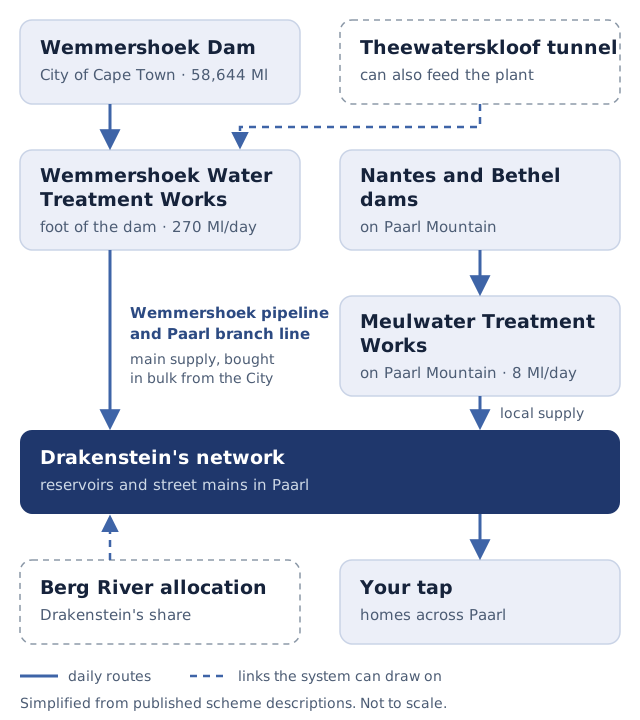
- Wemmershoek Dam supplies most of Paarl's water. Drakenstein buys it in bulk from the City of Cape Town, which owns the dam and the treatment works below it.
- It was 82.1% full on 19 October 2026, against 85.2% a year earlier. The wider supply system it belongs to was at 74.0%, against 89.7%.
- Restrictions are on the table on 2 November, when the Department of Water and Sanitation reviews the whole system. Drakenstein has been on Level 0 since November 2020. We will update this post after the meeting.
- Trouble at the Wemmershoek plant reaches Paarl as low pressure, an interruption or discoloured water. Most water-off days in Paarl are local repairs, though, not the dam.
- Wemmershoek water is soft. So if a Paarl geyser is scaling up quickly, look at its other water sources first, such as a borehole.
Wemmershoek Dam is where most of Paarl's tap water starts. On 19 October 2026 the dam was 82.1% full, a little below the 85.2% it held in the same week last year, so on its own it goes into summer in reasonable shape. The bigger concern is the regional supply system it belongs to, which is well down on last year, and the national water department meets on 2 November to consider whether that calls for restrictions.
This guide is written from the tap end of the pipe, by a plumber in Paarl, for Paarl homeowners. It covers where your water actually comes from, how full the dams are, what the 2 November meeting could change, and what a shutdown or a muddy-water week at the treatment works looks like inside your house. We will update it once the outcome of the meeting is published.
Which dam does Paarl get its water from?
Mainly Wemmershoek. Drakenstein Municipality's own environmental management framework puts it plainly: "most of the water in the Drakenstein Municipality is supplied locally from the Wemmershoek Dam", and "this water is purchased from the City of Cape Town".
The dam lies on the Wemmershoek River south-east of Paarl, with its catchment in the Wemmershoek Mountains. It was built for the City between 1953 and 1957 and holds 58,644 megalitres when full. An intake tower feeds the Wemmershoek Water Treatment Works at the foot of the dam. From there the Wemmershoek pipeline carries the treated water towards the City, and a branch pipeline off it supplies Paarl. The published description of the regional supply scheme gives the works a capacity of 270 megalitres a day.
Two smaller sources sit closer to home. Nantes Dam and Bethel Dam on Paarl Mountain were built to store water for the town through the year. Since 2012 that water has been treated at the Meulwater Treatment Works, which was built on the mountain above the existing Meulwater Reservoir with a capacity of 8 megalitres a day, according to the provincial minister's opening speech. Drakenstein also holds an allocation from the Berg River, through the Berg River (Riviersonderend) Government Water Scheme.
As for the size of each share, the scheme description gives Paarl's local scheme, Nantes and Bethel, a capacity of about 2.8 million cubic metres a year, against 17 million from Wemmershoek. Those are planning figures, not this year's actual use, but the proportions explain why Wemmershoek's level matters so much to Paarl.
Wemmershoek Dam level: how full it is this October
The City of Cape Town publishes the levels of its six major dams on its dam levels page every week. The figures for the week of 19 October 2026:
- Wemmershoek Dam: 82.1%, down from 84.4% the week before and 85.2% in the same week of 2025.
- The daily reading on 21 October: 81.5%.
- Full capacity: 58,644 megalitres, about 6.5% of the whole system's storage.
- The whole system: 74.0%, against 74.9% the week before and 89.7% a year ago.
It has been a dramatic year for this dam. Before the floods of 10 to 14 May it was down to 49.47%. By 1 June it had nearly doubled to 96.71%, the Paarl Post reported, against 53.65% at the same point in 2025.
Western Cape dams fill with the winter rain and draw down through the dry months, so the October figure is roughly the starting point for the summer ahead. Drakenstein's Save Water page, as it read on 22 October 2026, says that after "a drier-than-usual winter" the dams that supply the municipality are at 73%.
Why the whole system matters more than Wemmershoek alone
Wemmershoek is one dam in the Western Cape Water Supply System, which the City describes as "an integrated and collectively managed system of dams, pump stations, pipelines, and tunnels". Besides the City itself, it supplies towns in the Boland, which is where Paarl sits, and it provides irrigation water for farms.
Because the dams are run as one system, Wemmershoek's own level is not what decides whether Paarl faces restrictions. The national department looks at the system as a whole, and the system is weaker than Wemmershoek: 74.0% on 19 October against 89.7% a year earlier. Theewaterskloof, by far the largest dam in it, was at 73.9%.
There is a physical link too. The scheme description notes that the Wemmershoek Water Treatment Works can also be supplied with 140 megalitres a day from the Theewaterskloof tunnel at the Berg River Siphon. So the plant that treats most of Paarl's water is not tied only to its own dam.
Paarl water restrictions: what the 2 November meeting will consider
The Western Cape office of the Department of Water and Sanitation holds its annual operating analysis meeting on 2 November 2026. Its regional head, Ntombizanele Bila-Mupariwa, told EWN the meeting "will review the prevailing water resources situation and also consider the need for the implementation of water restrictions should circumstances warrant such measures."
Nobody can say yet what it will decide, and we are not going to guess. This is where Paarl stands going in:
- Drakenstein has been on Level 0 since 1 November 2020. Level 0 still allows garden watering with municipal water before 10:00 and after 16:00.
- The municipality is weighing restrictions. Its Save Water page (read on 22 October 2026) says it "is considering water restrictions as an additional proactive measure". It puts average household use at 487 litres a day, against a target of 463.
- It said as much last summer. In December 2025, Drakenstein's Director of Engineering Services, Louis Pienaar, told EWN: "No new water restrictions are in place, but this may change if dam levels continue to drop or if the National Department of Water and Sanitation issues a directive."
- Restrictions change the price of water as well as the rules. Drakenstein's 2026/27 tariff book already lists restriction tariffs. For a house with its own meter, water in the block from 15 to 30 kilolitres in a reading cycle costs R29.12 a kilolitre including VAT at the normal tariff, R38.71 at Level 1 and R157.02 at Level 2.
This post will be updated
We will add the outcome of the 2 November meeting here once the department or Drakenstein publishes it. Until then, Paarl remains on Level 0.
What a Wemmershoek shutdown looks like at a Paarl tap
Most of the time the dam and the plant are invisible. They show up at your tap in a few ways, and it helps to know which one you are dealing with.
A planned shutdown at the plant
The City's maintenance notice for the week of 11 May 2026 scheduled a day-long shutdown of the Wemmershoek Water Treatment Plant on 12 May, for urgent repairs to its MCC board and electrical components. It listed who would feel it, including "the Drakenstein Municipality connection" and the private users on the Wemmershoek pipeline. How much a shutdown like that shows in Paarl depends on how long it lasts and how much water is in the local reservoirs. Where it does show, homes high on the slope, such as the streets rising off Charleston Hill, are the first to lose pressure, for the reasons our post on why water pressure changes in Paarl explains.
Storm water in the dam
On 16 May, during the floods, the City reported that raw water quality, "particularly from the Wemmershoek and Theewaterskloof Dams", had deteriorated badly as mud and debris washed in from the mountain catchments, and that production at the Wemmershoek plant had been reduced. Its advice to its own customers was to report discoloured water and boil it as a precaution. In Paarl, discoloured water is reported to Drakenstein.
A local repair, which is the usual cause
Most water-off days in Paarl have nothing to do with the dam. On 4 February 2026 Drakenstein announced emergency maintenance at the corner of De Villiers and Breda Streets, which cut the supply to households between Verster and Waterkant Streets. Earlier this year the CBD and parts of Northern Paarl had reduced pressure while a burst pipe was repaired, and the municipality has sent a water cart to Paarl East during disruptions there. If only your street or suburb is affected, it is almost certainly a local job, not Wemmershoek.
Who do I call when the water is off in Paarl?
Start by working out whether it is just your house:
- Check next door. If your neighbours have water and you do not, the problem is on your side of the meter.
- Check your stopcock is fully open, especially if anyone has worked on the plumbing recently.
- If the pressure is weak rather than gone, close every tap and look at the meter. If it still turns, water is escaping somewhere on the property.
If the whole street is off, phone Drakenstein Municipality's toll-free customer care line on 080 131 3553, listed on its contact page, and check the municipality's Facebook page, where it posts planned and unplanned disruptions. If the fault is inside your property, such as a burst pipe, a valve that will not open or pressure that never came back, that is a job for a plumber.
Protecting your plumbing when the supply goes off and comes back
A shutdown on the Wemmershoek line, or a burst main down the road, is mostly an inconvenience. The plumbing risk comes when the water comes back. The first three points below are the City's standard advice for planned shutdowns. The rest protects your geyser and pipes.
- Before a planned shutdown, store drinking water in clean, sealed containers.
- Keep your taps closed while the water is off, so nothing runs or floods when the supply returns.
- Expect milky water for a while. Milky water just after the supply returns is trapped air, and it clears if you leave a glass to stand.
- Run a cold tap first. Open the garden tap, or the cold tap nearest the meter, and let it run until it is clear before you use any hot water. That sends dirt in the pipes down the drain instead of into your geyser.
- If the water stays brown, report it to Drakenstein and boil it as a precaution before you drink it.
- Listen to the pipes. Air in the line can make pipes bang as taps close. If the banging carries on long after the water is back, or the geyser's overflow pipe outside keeps running, have it looked at.
If a long shutdown, or restrictions, would leave your household stuck, the usual answer is storage: a tank with a pump that keeps the house running when the municipal supply drops. That is part of our water tank and backup pump installations in Paarl.
Is Wemmershoek water hard or soft?
Soft. In the City's tap water analysis for July 2024 to June 2025, water from the Wemmershoek supply measured 15 mg/L of hardness as calcium carbonate, with 41 mg/L of total dissolved solids. The US Geological Survey classes anything from 0 to 60 mg/L as soft.
Two caveats. Those figures are for the water leaving the Wemmershoek plant, not for the Paarl Mountain water from Meulwater, which is not in that report. And some Paarl properties also run on borehole water, which can be very different. If a geyser is scaling up quickly, ask where else its water comes from. Our guide to borehole water in Paarl covers what it does to a geyser.
Wemmershoek Dam and Paarl's water: common questions
Which dam supplies Paarl with water?
Mostly Wemmershoek Dam, south-east of Paarl, which the City of Cape Town owns. Drakenstein Municipality buys the treated water in bulk. Nantes and Bethel dams on Paarl Mountain add a smaller local supply, treated at the Meulwater Treatment Works, and Drakenstein also holds an allocation from the Berg River.
What is the Wemmershoek Dam level now?
82.1% for the week of 19 October 2026, and 81.5% on the City of Cape Town's daily reading of 21 October. In the same week a year earlier it was 85.2%. The City updates the figures every week on its dam levels page.
Will Paarl have water restrictions this summer?
It has not been decided. Drakenstein has been on Level 0 since 1 November 2020 and says it is considering restrictions. The Department of Water and Sanitation reviews the whole supply system at a meeting on 2 November 2026, where it will consider whether restrictions are needed. This post will be updated with the outcome.
Who do I call when the water is off in Paarl?
If the whole street is off, call Drakenstein Municipality's toll-free customer care line on 080 131 3553. If only your house is off, or the water came back and something is now leaking, banging or overflowing, call a plumber.
Why is my water milky or brown after it comes back on?
Milky water after a shutdown is usually air trapped in the pipes, and it clears if you let a glass stand. Brown or discoloured water is different: report it to Drakenstein and boil it as a precaution until it runs clear. Running a cold tap first, before any hot tap, keeps that dirt out of your geyser.
If the water comes back and something in the house is not right, such as a geyser overflow that will not stop, pipes that keep banging or pressure that never recovers, call The Paarl Plumbers on 087 721 5464.
Dam levels are the City of Cape Town's figures for the week of 19 October 2026 and the daily reading of 21 October 2026. Drakenstein's Save Water and contact pages were read on 22 October 2026. This post will be updated after the Department of Water and Sanitation's meeting on 2 November 2026.